
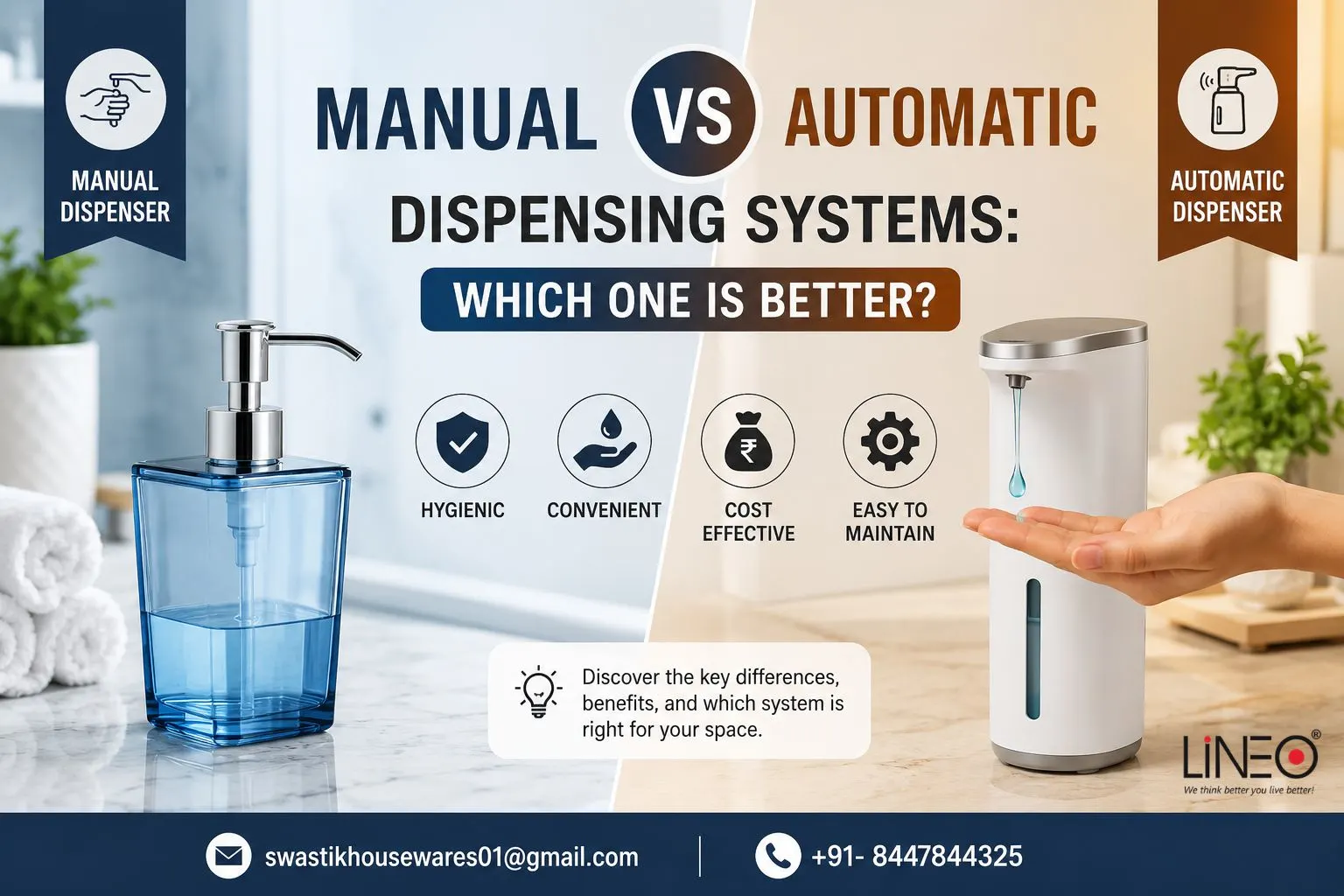
Any modern office, hospital, hotel, restaurant, or shopping mall requires an effective dispensing system for maintaining hygiene. Although there is nothing fancy about it, the selection of a dispensing system may influence the level of cleanliness as well as maintenance expenses.
One of the key questions, which almost everyone asks themselves, is whether to purchase a manual or automatic dispenser.
This choice depends not only on your budget but also on the number of people who will use it. To assist you in the process of making a decision, we shall analyse both systems.
What is a Manual Dispenser?
A manual dispenser is a kind of system that dispenses the substance by pressing a button, lever, or using a pump. Such dispensers have been popular for several decades.
Benefits of Manual Dispensers
- Low initial purchase price
- Does not need batteries or any electricity
- Simple installation and maintenance
- Very durable due to reduced electronic parts
- Good for low to moderate traffic restrooms
Manual dispensers continue to be viable options in schools, small offices, residential properties, and staff restrooms.
Drawbacks
Manual dispensers require users to press a button, lever, or push mechanism during operation. In high-traffic environments, they may require more frequent cleaning to maintain hygiene standards. However, they remain a reliable, durable, and cost-effective choice for many facilities.
What is an Automatic Dispenser
It is an advanced system integrated with Infrared sensor technology to detect hands and dispense soap without coming into direct contact with the surface. Over the last couple of years, touchless systems have gained popularity in hospitals, airports, hotels, and corporate offices due to reduced surface contact.
Benefits of Automatic Soap Dispensers
- No touching means better hygiene
- Prevents cross-contamination
- Gives out a uniform amount of soap each time
- Makes wastage minimum
- Gives a stylish and premium look
- Suitable for places where there is heavy traffic
Several automatic soap dispensers run on batteries, whereas some are rechargeable or run by an electric supply.
Drawbacks
The automatic dispensers are always more expensive than the manual ones. They also require occasional battery changing or charging and regular cleaning of sensors.
Manual vs Automatic Dispensing Systems
Parameter | Manual Soap Dispenser | Automatic Soap Dispenser |
Cost Factor | Lower | Higher |
Hygiene | Good | Excellent (Touch-Free) |
Maintenance | Very little | Moderate |
Control on the Amount of Soap | Depends on the user | Uniform and accurate |
Source of Power | None | Batteries or electricity |
Best Suited For | Homes, schools, and office buildings | Hospitals, hotels, malls, offices, and airports |
Which Saves More Money?
The manual dispenser appears to be less expensive due to its low purchase cost, and this advantage often extends beyond the initial investment. Since manual systems do not require batteries, charging, or electronic components, they generally involve lower maintenance and operating costs.
A well-designed manual dispenser can also provide controlled dispensing, helping reduce unnecessary product usage while ensuring reliable performance. This makes it a practical and cost-effective solution for offices, schools, institutions, and commercial facilities.
Which One Should You Choose?
The answer to the question above is not the same for everyone.
Select a manual dispenser in case:
- Your budget is limited
- You want a proven, effective solution
- Your washrooms have low traffic
- You require low-maintenance operation
Pick up an automatic dispenser in case:
- You want to ensure good hygiene
- You have commercial washrooms with high traffic
- You need to save soap
- You want a more hygienic, professional washroom
In many companies, both dispensers are currently used. Automatic dispensers can be installed in the washrooms available to visitors, while manual ones can be used in the staff restrooms.
When selecting a quality product from the Soap Dispenser Manufacturers in India, you should pay attention to such features as quality of materials, volume of refills, longevity, maintenance, and after-sales service.
Final Thoughts
Both types of soap dispensing systems perform one task to ensure good hygiene, but they work perfectly in different environments.
Manual dispensers remain a reliable and inexpensive solution. Automatic dispensers offer better hygiene, precise dispensing, and a premium user experience, which makes them a perfect choice for commercial and public washrooms.
Before buying a dispenser, you should consider your washroom’s usage frequency, maintenance capabilities, and the total costs of operation.
Frequently Asked Questions
Automatic soap dispensers are more hygienic since there is no contact between the dispenser and the user.
Automatic dispensing systems are generally preferred for high-traffic washrooms because they offer touch-free operation, better hygiene, and controlled product usage.
Yes, touchless dispensing systems help reduce surface contact and lower the risk of cross-contamination in public and commercial washrooms.
Automatic systems dispense a fixed quantity during each use, helping reduce overuse and unnecessary wastage.
Manual dispensing systems are often suitable for schools, staff washrooms, and small offices due to their affordability and simple maintenance.
Yes, many organizations install automatic units in visitor areas and manual units in staff or low-traffic washrooms to balance cost and convenience.
Of course. Automatic dispensers release only a certain quantity of soap per use.